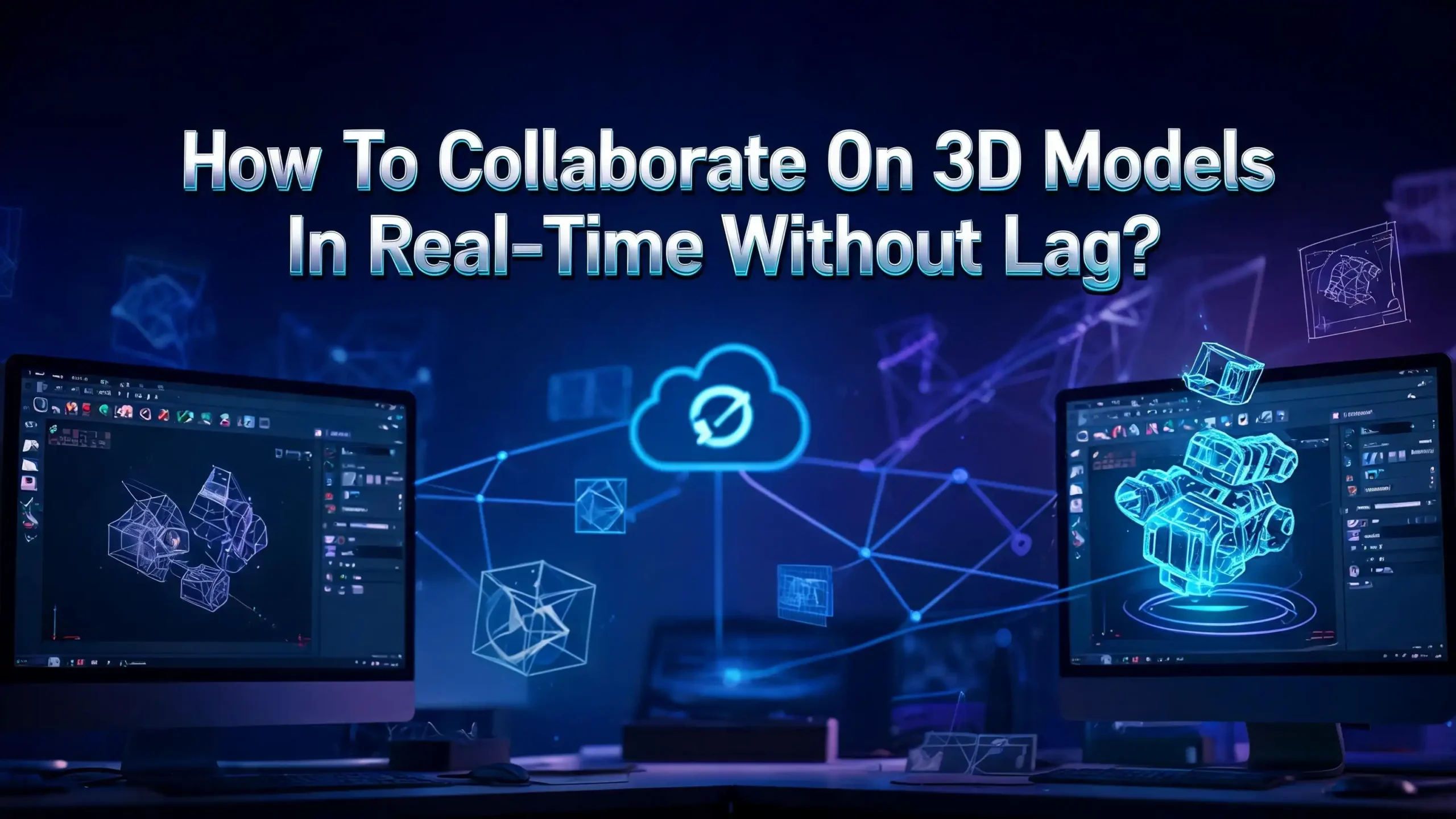
How To Collaborate On 3D Models In Real Time Without Lag?
Working on a 3D model with your team should feel smooth and instant. But if you have ever tried editing the same scene with a colleague across the globe, you know the frustration. Delayed updates, version conflicts, and sluggish viewports can turn a creative session into a productivity nightmare.
The good news? Real time 3D collaboration without lag is absolutely possible in 2026. Cloud platforms, open file standards, and smarter network setups have made it easier than ever for distributed teams to create together.
This guide gives you practical, actionable solutions to every common lag and collaboration problem. You will learn how to choose the right platform, optimize your files, configure your network, manage versions, and structure your workflow so that every team member stays in sync.
In a Nutshell
- Choose cloud native platforms built for 3D collaboration. Tools like NVIDIA Omniverse, Onshape, and browser based 3D editors let multiple users edit the same scene at once with built in synchronization. They handle the heavy lifting of data transfer and conflict resolution behind the scenes.
- Optimize your 3D models before collaborative sessions. High polygon counts and oversized textures are the top causes of lag during real time editing. Reduce polygon density, compress textures, and use Level of Detail (LOD) systems to keep the viewport responsive for everyone.
- Use Universal Scene Description (OpenUSD) as your interchange format. OpenUSD supports non destructive layered editing, which means multiple artists can contribute to the same scene without overwriting each other’s work. It is the emerging standard for 3D interoperability.
- Stabilize your network with low latency as the priority. Raw bandwidth matters less than consistent, low latency connections. A wired Ethernet setup with at least 50 Mbps upload speed and latency under 50 milliseconds creates a reliable foundation for real time sessions.
- Establish version control and clear team protocols. Use systems like Perforce Helix Core or Git LFS to track every change to your 3D assets. Pair this with naming conventions, defined review cycles, and role based permissions so your team avoids confusion and file conflicts.
Why Real Time 3D Collaboration Often Feels Laggy
Most lag during collaborative 3D work does not come from a single source. It is usually a combination of large file sizes, high polygon scenes, network instability, and poorly optimized synchronization. Understanding each factor helps you fix the right problem.
A typical 3D scene for product design or VFX can contain millions of polygons, multiple 4K or 8K texture maps, and complex material graphs. When two or more users try to edit this scene at the same time, every change must be transmitted, validated, and rendered on each participant’s machine. If any part of that chain is slow, everyone feels it.
Network latency adds another layer. Even with fast internet speeds, data packets traveling between distant locations introduce delays. A 200 millisecond round trip between New York and Tokyo means every edit takes at least that long to appear on the other person’s screen. Multiply that by hundreds of small edits per minute and the lag compounds fast.
Software architecture matters too. Applications that were designed for single user workflows and later added collaboration features often struggle. They were not built to handle concurrent edits, conflict resolution, or incremental data syncing from the ground up. Choosing a platform that was designed for real time collaboration from day one makes a significant difference.
Choose a Platform Built for Real Time Collaboration
The single most impactful decision you can make is selecting the right collaboration platform. Not all 3D software handles multi user editing equally. Some tools offer true simultaneous editing while others only provide file sharing with basic commenting.
NVIDIA Omniverse uses the OpenUSD framework to let multiple users work on different layers of the same scene simultaneously. Each artist’s changes are synced through a central Nucleus server. This means a lighting artist can adjust lights while a modeler refines geometry in the same file, without either one blocking the other.
Onshape is a cloud native CAD platform where all data lives on servers. Multiple engineers can edit the same assembly at the same time through a web browser. There is no file to download, no version to track manually, and no merge conflict to resolve. The platform handles all of that automatically.
Browser based 3D tools such as Womp and Vectary offer accessible entry points for smaller teams. They require no software installation and work on any device with a modern browser. While they may not handle the extreme complexity of VFX scenes, they are excellent for product design, prototyping, and creative exploration.
When evaluating platforms, ask three questions. Does it support true simultaneous editing? Does it sync changes incrementally rather than uploading entire files? Does it work with your existing pipeline tools? A yes to all three means you are on the right track.
Optimize Your 3D Models for Smooth Performance
Even the best collaboration platform will struggle if your 3D models are unnecessarily heavy. File optimization is the foundation of lag free collaboration. Every polygon, texture, and material node you can simplify reduces the amount of data that must sync between users.
Start with polygon reduction. Most models contain far more geometry than needed for real time editing. Use decimation tools in Blender, Maya, or dedicated software like InstaLOD to reduce polygon counts by 50% to 90% without visible quality loss. Save the high resolution version for final rendering and use a lighter version for collaborative work.
Texture optimization is equally important. A single 8K texture map can be 256 MB uncompressed. Multiply that by dozens of materials in a scene and you have gigabytes of texture data to transfer. Resize textures to 1K or 2K for collaborative sessions. Use compressed formats like PNG or KTX2 that reduce file size while preserving visual quality.
Implement Level of Detail (LOD) systems in your scenes. LOD automatically swaps high resolution models for simpler versions when objects are far from the camera. This keeps the viewport fast for all collaborators while maintaining visual fidelity where it matters most. Most game engines and many DCC tools support LOD natively.
Clean up your scene files regularly. Delete unused materials, remove hidden objects, and flatten unnecessary layer hierarchies. A lean scene file is a fast scene file.
Use OpenUSD for Non Destructive Multi User Editing
Universal Scene Description (OpenUSD) is rapidly becoming the standard format for collaborative 3D work. Developed by Pixar and now maintained as an open source project, OpenUSD solves a fundamental problem: how can multiple people edit the same scene without destroying each other’s work?
The answer is layered composition. In OpenUSD, a scene is built from multiple layers stacked on top of each other. One layer might contain geometry. Another holds materials. A third defines lighting. Each artist works on their own layer, and the system composes all layers together into a single coherent scene.
This means a modeler can adjust the shape of a building while a lighting artist changes the sun angle, and neither edit touches the other’s layer. There are no merge conflicts and no accidental overwrites. The system is designed for exactly this kind of parallel work.
NVIDIA Omniverse, Apple’s Reality Composer, Autodesk Maya, and many other tools now support OpenUSD natively. If your team uses different software packages, OpenUSD acts as the common language that lets everyone contribute to the same scene. Adopting OpenUSD early positions your pipeline for long term interoperability as more tools add support.
To get started, export your assets in USD format and set up a shared repository where layers are stored. Define clear ownership of layers so each team member knows which layer they edit.
Configure Your Network for Low Latency
Network performance is the invisible factor that determines whether real time collaboration feels instant or painful. You can optimize every model and choose the best platform, but a bad network connection will still cause lag.
Prioritize latency over bandwidth. Bandwidth determines how much data you can send per second. Latency determines how long each piece of data takes to arrive. For real time collaboration, low latency matters more. A connection with 50 Mbps bandwidth and 20 milliseconds latency will feel much smoother than one with 500 Mbps and 150 milliseconds latency.
Use a wired Ethernet connection instead of Wi Fi. Wi Fi introduces variable latency due to interference, congestion, and signal strength changes. A direct Ethernet cable to your router eliminates these variables and provides consistent, predictable performance.
If your team is spread across multiple regions, consider using a Content Delivery Network (CDN) or edge server close to each team member. Some collaboration platforms offer regional server options. NVIDIA Omniverse Nucleus, for example, can be deployed on premises or in cloud data centers close to your team. This reduces the physical distance data must travel.
Close unnecessary applications that consume bandwidth during collaborative sessions. Video streaming, large downloads, and cloud backups can all compete with your 3D sync traffic. Quality of Service (QoS) settings on your router can prioritize collaboration traffic over other network activity.
Set Up Proper Version Control for 3D Assets
Without version control, collaborative 3D work quickly becomes chaotic. Two people editing the same file at the same time without a system to track changes will create conflicts, lost work, and confusion about which version is current.
Perforce Helix Core is the industry standard for large binary files like 3D models, textures, and animations. It supports file locking, which prevents two artists from editing the same asset simultaneously. It also maintains a complete revision history, so you can always roll back to a previous version if something goes wrong.
For smaller teams or open source projects, Git with Large File Storage (Git LFS) is a practical alternative. Standard Git does not handle large binary files well. Git LFS extends Git to track these files efficiently. Store your 3D assets in Git LFS and your project files, scripts, and documentation in standard Git.
Establish naming conventions that every team member follows. A file named “chair_v03_john_lighting.usd” tells you the asset name, version number, author, and what was changed. This simple practice eliminates the “final_FINAL_v2_updated” problem that plagues unstructured projects.
Pair version control with regular review checkpoints. Schedule brief sync meetings where the team reviews recent changes, resolves any conflicts, and aligns on next steps. This prevents divergent work from accumulating into major integration headaches.
Structure Your Team Workflow for Parallel Editing
Real time collaboration works best when your workflow is designed for parallel work, not sequential handoffs. If every task depends on the previous one finishing, adding more collaborators does not speed anything up.
Break your project into independent modules that different team members can work on simultaneously. In an architectural visualization, one artist handles the building exterior while another creates the interior. A third sets up the landscape. Each module connects to the others through well defined interfaces, but can be developed independently.
Define clear ownership of scene layers or asset groups. When everyone knows exactly what they are responsible for, the risk of conflicting edits drops dramatically. Use your collaboration platform’s permission system to enforce these boundaries. Some platforms let you lock specific objects or layers so only the assigned artist can modify them.
Establish a daily or twice daily sync rhythm where the team reviews progress together. This does not need to be a long meeting. A 10 to 15 minute standup where each person shows their latest changes keeps everyone aligned. Real time collaboration platforms make these reviews fast because everyone can see the current state of the scene instantly.
Document your workflow agreements in a shared document or wiki. Include layer naming rules, review schedules, file organization standards, and escalation procedures for conflicts. Written guidelines prevent misunderstandings that verbal agreements often create.
Leverage Cloud Rendering to Free Up Local Resources
One major source of lag during collaboration is local hardware struggling to render complex scenes while also syncing data. Cloud rendering solves this by offloading the heavy computation to remote servers.
Services like cloud render farms process your scenes on powerful GPU clusters while your local machine stays free for modeling, texturing, and other interactive work. You submit a render job, and the cloud handles it. This is especially valuable during collaborative sessions where your computer needs every bit of processing power for the real time viewport.
Integrate cloud rendering directly into your collaboration pipeline. Many platforms support one click submission to cloud render services from within the application. This eliminates the need to export files, upload them manually, and manage the render queue separately.
Preview renders in the cloud are also valuable for collaborative reviews. Instead of waiting for each team member’s local machine to generate a preview, a cloud render can produce a high quality image or turntable animation in minutes. Share the result in your review tool and get feedback fast.
For teams on a budget, use cloud rendering selectively. Render final frames and complex previews in the cloud. Handle quick viewport previews locally. This hybrid approach gives you the best of both worlds without excessive cloud costs.
Use Review and Annotation Tools for Clear Feedback
Lag in collaboration is not only technical. Communication lag from unclear feedback and misunderstood comments wastes just as much time as network latency.
Use visual review tools that let team members and stakeholders annotate directly on 3D renders or viewport screenshots. Platforms like SyncSketch and ftrack allow frame accurate comments, drawn annotations, and side by side version comparisons. When a reviewer circles a specific area and writes “smooth this edge,” there is no ambiguity.
Integrate your review tool with your collaboration platform so that feedback flows directly to the responsible artist. A comment on a specific model should appear in that artist’s task list automatically. This closed loop prevents feedback from getting lost in email threads or chat messages.
For real time review sessions, use the collaboration platform’s built in tools to walk through the scene together. One person can navigate the camera while others observe and comment. This is far more effective than screen sharing because every participant sees the full quality 3D scene on their own hardware, not a compressed video stream.
Keep feedback specific and actionable. Instead of “this does not look right,” write “the metal material on the left panel is too reflective; reduce roughness to 0.3.” Specific feedback eliminates guesswork and reduces the number of revision cycles needed.
Handle Large Assemblies with Scene Segmentation
Massive 3D scenes are the biggest challenge for real time collaboration. A city block with thousands of buildings, a factory floor with hundreds of machines, or a film set with complex environments can overwhelm any platform if loaded as a single monolithic file.
The solution is scene segmentation. Break your large scene into smaller referenced files that load independently. OpenUSD excels at this through its reference and payload mechanisms. Each building in your city can be a separate USD file that the master scene references. Artists edit individual buildings without loading the entire city.
Use proxy objects for elements that are visible but not being edited. A low resolution placeholder for a distant building consumes far less memory and bandwidth than the full detail model. When an artist needs to work on that building, they switch from the proxy to the full model.
Set up streaming or progressive loading if your platform supports it. Instead of loading the entire scene before anyone can start working, the platform loads nearby objects first and fills in distant detail over time. This gets everyone into the scene faster and reduces the initial sync time significantly.
Plan your scene hierarchy with collaboration in mind from the start. A well organized hierarchy with logical groupings makes it easy to assign sections to different team members. Retrofitting segmentation onto a monolithic scene is always harder than building it in from the beginning.
Manage Hardware Requirements Across Your Team
Real time collaboration demands that every team member has adequate hardware. The weakest machine in the group can become a bottleneck that slows everyone down, especially if the platform must wait for all users to sync before confirming changes.
Set minimum hardware specifications for your team. For most 3D collaboration platforms, you need a dedicated GPU with at least 8 GB VRAM, 32 GB of system RAM, and a solid state drive for fast file access. More complex projects may require 16 GB VRAM and 64 GB RAM.
If some team members have weaker machines, use viewport quality settings to reduce the rendering load on their systems. Lower resolution previews, simplified shading modes, and reduced shadow quality can keep the viewport responsive without affecting the final output quality.
Cloud workstations are an alternative for teams where hardware upgrades are not practical. Services that provide remote access to powerful machines let artists work on high spec hardware through a thin client. The 3D processing happens in the cloud, and only the screen output streams to the user’s local device. This equalizes performance across the team regardless of local hardware.
Maintain your hardware regularly. Update GPU drivers, clear temporary files, and ensure sufficient free disk space. A system running low on storage or using outdated drivers can introduce lag that has nothing to do with your network or collaboration platform.
Establish Security Protocols for Shared 3D Work
Collaboration means sharing access to valuable intellectual property. Without proper security, your 3D assets are vulnerable to unauthorized access, accidental deletion, or data leaks.
Use role based permissions on your collaboration platform. Give each team member access only to the assets and layers they need. A junior artist working on props does not need edit access to the hero character file. Limiting permissions reduces the risk of accidental changes to critical assets.
Enable two factor authentication for all accounts on your collaboration platform and version control system. This simple step blocks the majority of unauthorized access attempts. Require it as a team policy, not just a recommendation.
Encrypt data both in transit and at rest. Check that your platform uses TLS for all network communication and encrypts stored files. If you are working on NDA protected projects, verify that the platform provider meets security standards like SOC 2 or ISO 27001.
Maintain audit logs that record who accessed, modified, or downloaded each asset. If a problem occurs, these logs help you identify what happened and when. Most enterprise collaboration platforms include audit logging as a standard feature.
Combine Synchronous and Asynchronous Workflows
Not every collaborative task requires real time interaction. Forcing all work into synchronous sessions can create fatigue and reduce productivity, especially for teams spread across many time zones.
Use real time collaboration for tasks that benefit from immediate feedback: design reviews, brainstorming sessions, and critical decision points. These are moments where seeing each other’s changes instantly saves hours of back and forth communication.
Shift detailed, heads down work to asynchronous mode. A modeler refining edge loops or a texture artist painting maps often works best with uninterrupted focus time. They can upload their changes to the shared scene when ready, and other team members review the work during their own working hours.
Set up your platform to support both modes. Clear status indicators show when a team member is actively editing in real time versus working offline. Notification systems alert the right people when new changes are ready for review. This hybrid approach respects individual work styles while maintaining team coordination.
Schedule synchronous review windows that overlap across time zones. Even a 30 minute window where the whole team can gather provides enough time to align on priorities, resolve blockers, and maintain team cohesion. Record these sessions for anyone who cannot attend live.
Troubleshoot Common Lag Issues Quickly
Even with a well configured setup, lag can still appear. Knowing how to diagnose and fix common problems saves you from losing productive hours.
If the viewport is slow for one user but not others, the problem is likely local hardware or network. Check GPU utilization, RAM usage, and network latency. A quick speed test and system monitor will reveal the bottleneck. Restarting the application often clears memory leaks that accumulate during long sessions.
If everyone experiences lag simultaneously, the issue is probably scene complexity or server load. Try hiding objects that are not currently being edited. Reduce viewport quality settings. If you are using a self hosted Nucleus server, check its CPU and memory usage and consider allocating more resources.
Sync conflicts appear when two users accidentally edit the same object at the same time on platforms that do not fully support concurrent editing. The fix is to define clearer ownership boundaries and use object locking features. Most platforms highlight conflicts immediately so you can resolve them before they cascade.
Keep a troubleshooting checklist accessible to your team. Include steps like checking network status, verifying GPU drivers, clearing cache files, and restarting the collaboration server. When lag strikes during a deadline, having a clear procedure prevents panic and wasted time.
FAQs
What internet speed do I need for real time 3D collaboration?
A stable connection with at least 50 Mbps download and upload speed works for most platforms. However, low latency is more important than raw speed. Aim for under 50 milliseconds of latency to your collaboration server. Use a wired Ethernet connection for the most consistent performance.
Can I collaborate in real time using Blender?
Blender does not have built in real time collaboration for simultaneous editing in a single session. However, you can export Blender scenes to OpenUSD format and collaborate through platforms like NVIDIA Omniverse. Some community add ons also offer experimental multi user editing within Blender.
Is cloud based 3D collaboration secure for commercial projects?
Yes, if you choose platforms that offer encryption, role based access control, two factor authentication, and audit logging. Verify that the provider meets recognized security standards like SOC 2 or ISO 27001. For highly sensitive work, consider platforms that allow on premises deployment.
How do I prevent version conflicts during multi user editing?
Use a version control system like Perforce Helix Core or Git LFS. Define clear ownership of assets and scene layers. Enable file locking for critical files that should only be edited by one person at a time. Schedule regular sync checkpoints to catch and resolve conflicts early.
What file format is best for collaborative 3D workflows?
OpenUSD is the leading format for multi user 3D collaboration. Its layered composition system lets multiple artists edit different aspects of the same scene without overwriting each other. It is supported by major tools including NVIDIA Omniverse, Autodesk Maya, SideFX Houdini, and Apple’s creative applications.
Does real time 3D collaboration work with large scenes over one million polygons?
Yes, but you need to segment the scene into smaller referenced files and use LOD systems and proxy objects. Load only the sections being actively edited at full detail. Progressive loading and viewport optimization settings keep the experience smooth even with very complex environments.

Hi, I’m Lusi. I’m a tech enthusiast who loves digging into gadgets, testing products, and helping people find the best tech for their needs and budget. Got a question or a product you’d like me to review? Drop me a mail— I’d love to hear from you!